
Franz Schubert (1797-1828) was an Austrian composer born in Himmelpfortgrund. He started learning the piano from his brother, Ignaz, at the age of five. However, he announced after a few months, that he had “no need of any further instruction”. Holzer, the local parish organist, gave Schubert a grounding in piano, organ, and figured bass. He then played viola in his family string quartet, writing his first quartets for them. Schubert began studying at the Stadtkonvikt(Imperial Seminary) on a choral scholarship. It was there he developed an admiration for Beethoven, particularly his overtures. After periods teaching at his father’s school, accompanying and writing operas, more of his works, from 1823, were being published. From 1823 alone came his eighth symphony, the ‘Unfinished’ and his first large-scale song cycle, die schöne Müllerin. Die Forelle, arguably, was written in 1819, but was published posthumously in 1829.
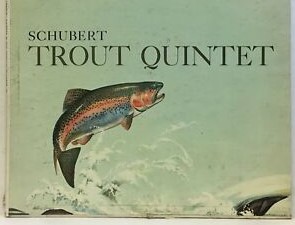
The name of this quintet, die Forellenquintett (“Trout” Quintet), comes from the theme in the fourth movement, which is based on Schubert’s earlier Lied “Die Forelle”. The inclusion of this Lied was the suggestion of Sylvester Paumgartner, an amateur ‘cellist and the man who gave the work its patronage. There are two interesting aspects of Die Forelle, the five-movement structure and the inclusion of the double bass. Both stem from the same place, the opus 87 piano quintet by Hummel. A quintet is conventionally piano and string quartet: Hummel’s decision was to substitute the second violin for double bass. Furthermore, Hummel wrote his op. 74, a wind septet, also including a double bass. The most intriguing aspect of the scoring is that no other of Schubert’s contemporaries, included a double bass in their piano quintets or string quartets neither Beethoven (despite including a double bass in his wind septet) nor his predecessors, Haydn and Mozart. Furthermore, the Hummel op. 87 also contains five movements, including a theme and variations, for the fourth movement, as does die Forelle.
Theme
The theme starts in the key D major, a semitone higher than the original Lied, with the strings, playing a quasi-chorale melody. Several musical aspects played first here, become the emphasis of later variations, all have been corrupted from earlier in the piece, or from the Lied. For example, the string portato (b.1 in all the strings) comes first in die Forelle in b. 25 and briefly appears in the Lied in bb.62-3. The dotted rhythms are more ambiguous, as the lied uses even notes. According to M. J. E. Brown, editor of the 1974 Edition Eulenburg score (the edition from which the author is working), Schubert “made certain changes in the melody… to render the tune more instrumental”. Trills, ornaments, added dotted rhythms are all cited by the above, as ways Schubert did this. The theme is set up into two-bar phrases often with a healthy dose of repetition and without the complex semiquaver sextuplet rhythmic motif accompaniment, of the Lied.
Variation I
The piano assumes control with the theme played in octaves, decorated by ornaments. The slurring changes to being between b. 212-3, rather than the whole bar, further changes exist. The strings can be divided into two here: the viola and double bass, who play an arpeggio motif (albeit the violas triplet semiquavers and bass as staccato quavers) and the violin and ‘cello who pass a triplet semiquaver motif between eachother. This motif is a corruption of the complex semiquaver sextuplet rhythmic motif, as found in the Lied. The second half, of the variation, sees a continuation, but with the violin occasionally launching into the stratosphere, as violinists tend to do.
Variation II
This variation is where the violinist earns their wages, by continuously playing triplet semiquavers. In the violin part, two interesting things happen: portati are used in bb. 49, 51, 55. Underneath that, the remaining continue with the tune passed between the strings and piano, until the cadence. It is a much grander section this, grandure derived from louder dynamics and thicker textures. From b. 49 onwards, the viola, ‘cello and bass play together, alternating with the piano.
Variation III
In a surprising move, the double bass and ‘cello are given the theme, albeit dwarfed by the sheer virtuosity of the piano, playing its demi-semiquavers. The upbeat contains a trill utilising the chromatic neighbour-note. Further on, in the first- and second-time bars, there is an ascending chromatic scale, played by the piano. Schubert shifts where the beat of each bar falls, in b.67 for example, by displacing the strong beat of the bar, through the phrasing of the demi-semiquavers. The violin, having a rare moment out of the spotlight, and the viola conspire together creating the accompaniment, with some, at times, jovial, off-beat semiquaver chords.
Variation IV
Until this point, the variations had been rooted in D major and the theme has been prominent: both change here. We move to D minor, though the up-beat of octave A’s create harmonic ambiguity, and the theme ostensibly disappears. Instead, triplet semiquaver chords appear antiphonically in the piano and upper strings. Underneath, the ‘cello and bass play a tricky motif, tricky for the bass at least. The most interesting aspect of this, aside of the sheer virtuosity being demonstrate by the double bass, is the D-G sharp-A pattern. The G sharp is diminished fifth below the D, an interval otherwise known as the devil’s interval. The fortissimo chords are contrasted with a more lyrical, major, pianissimo section, featuring a dialogue between the piano and violin. Ultimately, despite indications of movement back towards a major key, landing in D minor. At this moment, the trills which have been such a prominent feature of this movement are repeated by the piano, b.93-100, this offbeat chordal pattern appears, which derives from the Lied.
Variation V
This variation corrupts the Lied’s original melody one step further, by introducing a double-dotted version of the melody. It is played first by the ‘cello before being imitated by the piano. The violin adds a simple counter-melody, whilst the viola and double bass play the accompaniment. Harmonically, this variation becomes interesting from b. 114 onwards. The harmonic progression is thus, Gb minor – Db major (the original key of the Lied) – Ab major – Db major (this then repeats) – Ab major – Db major – E major – A major – C# major – F# major – A major. There isn’t an obvious pattern as to how this harmony works; there are plagal and perfect cadences, amongst other stranger cadences. Instead, the following chord always has one note of the previous chord contained within it, occasionally two. That is how Schubert manages to take from Db major to A major (which then allows us back to safer ground in D major).
Allegretto
The Allegretto, or coda, introduces a new rhythmic idea, new for the piece that is. These five sextuplet semiquavers form the vast majority of the accompaniment in the original Lied. The quintet’s coda is texturally thin, with all the instruments playing together only in the last eight bars. The violin and piano exchange the rhythmic idea, the violin and ‘cello the theme and the viola and double bass do their duties accompanying. In b.17, the piano increases the unease, instability and interest of the movement when it has a chromatic feature, which gets repeated later. The cadence runs thus, V7 – I, that is A major seventh to D major. It is a rather simple end to the movement, which proffers rhythmic and harmonic interest throughout, testing the instrumentalists often.
George Roberts, Divisions







 King Edward's Music