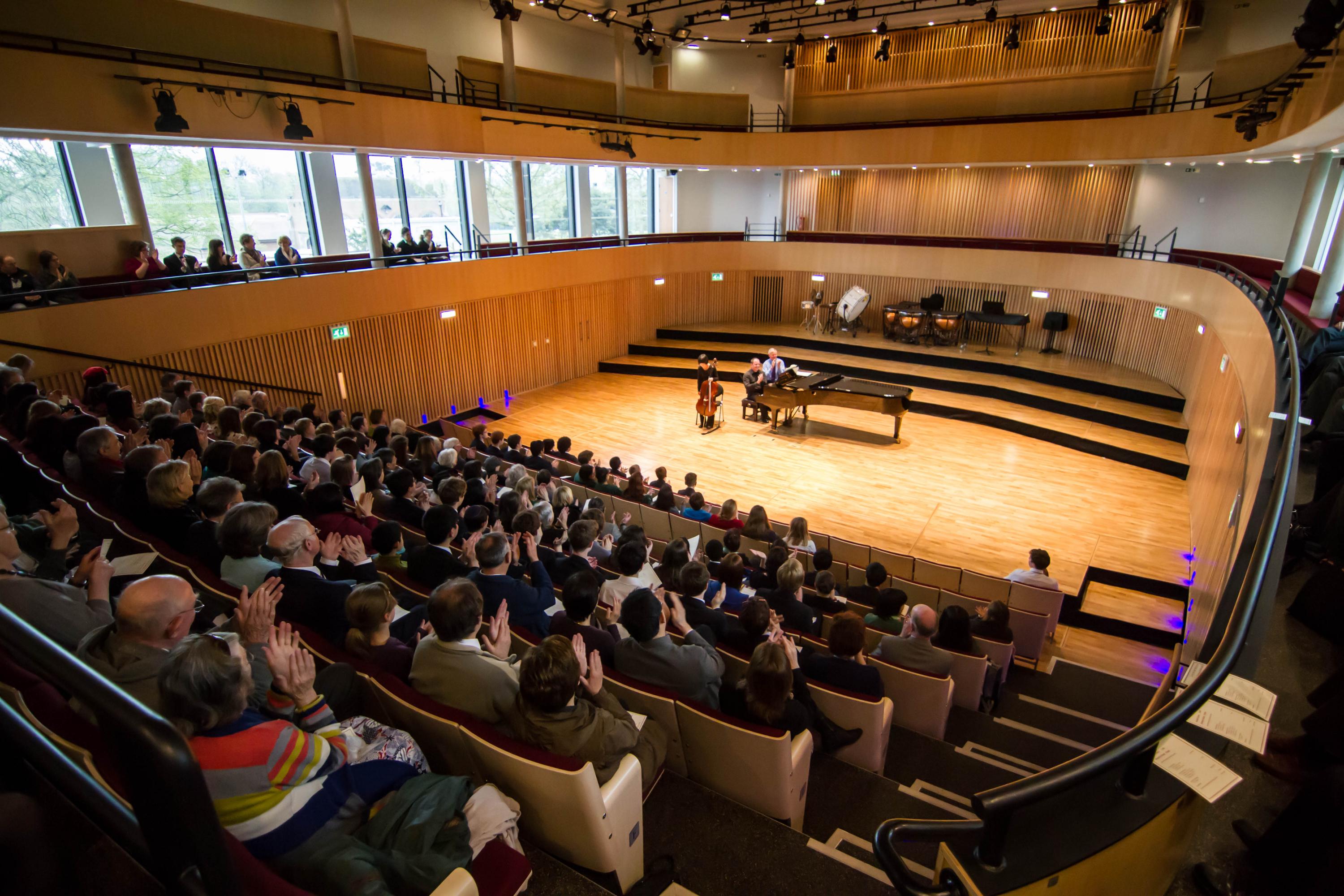
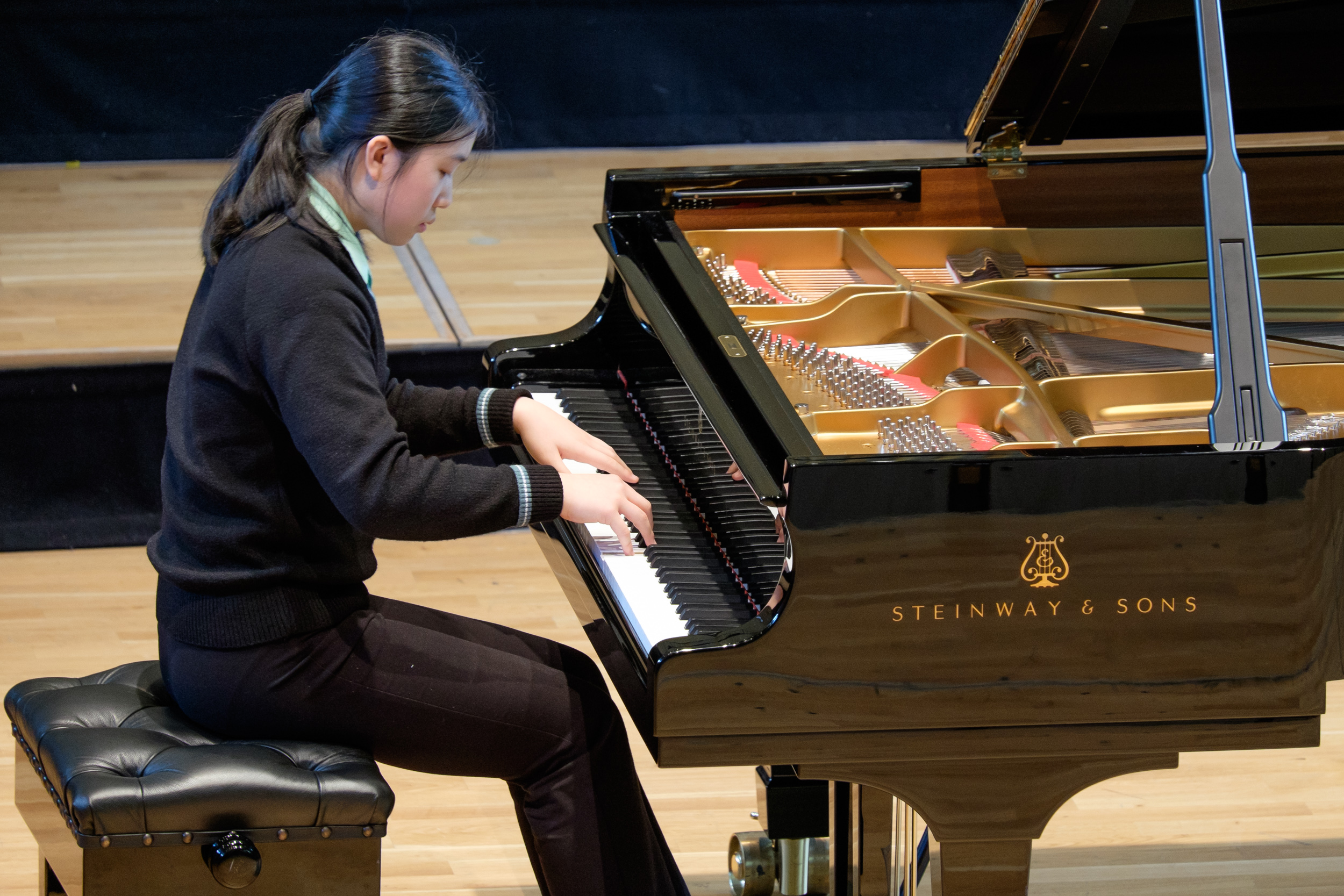
From the Instrumental Evening on 5 March 2018


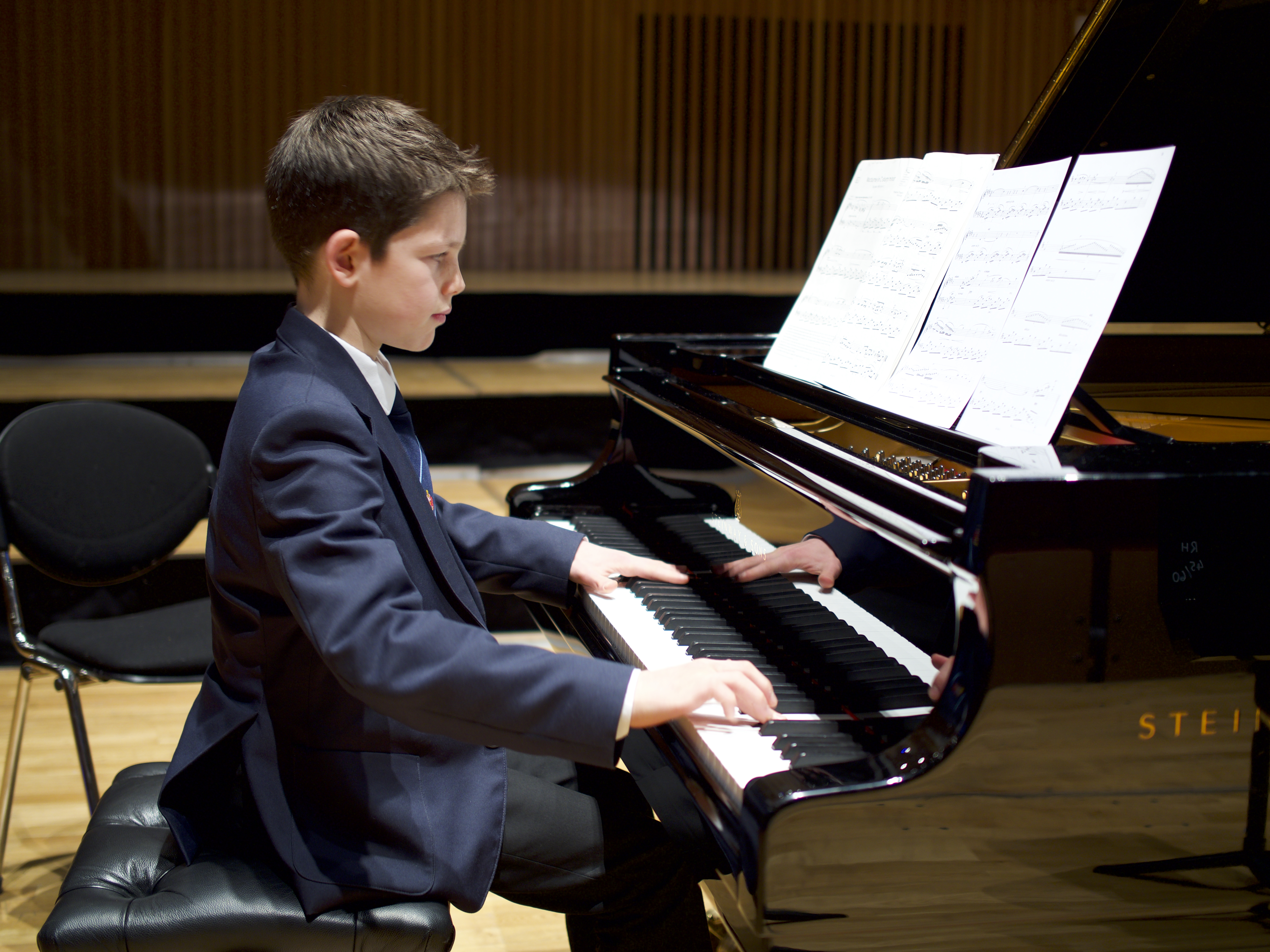
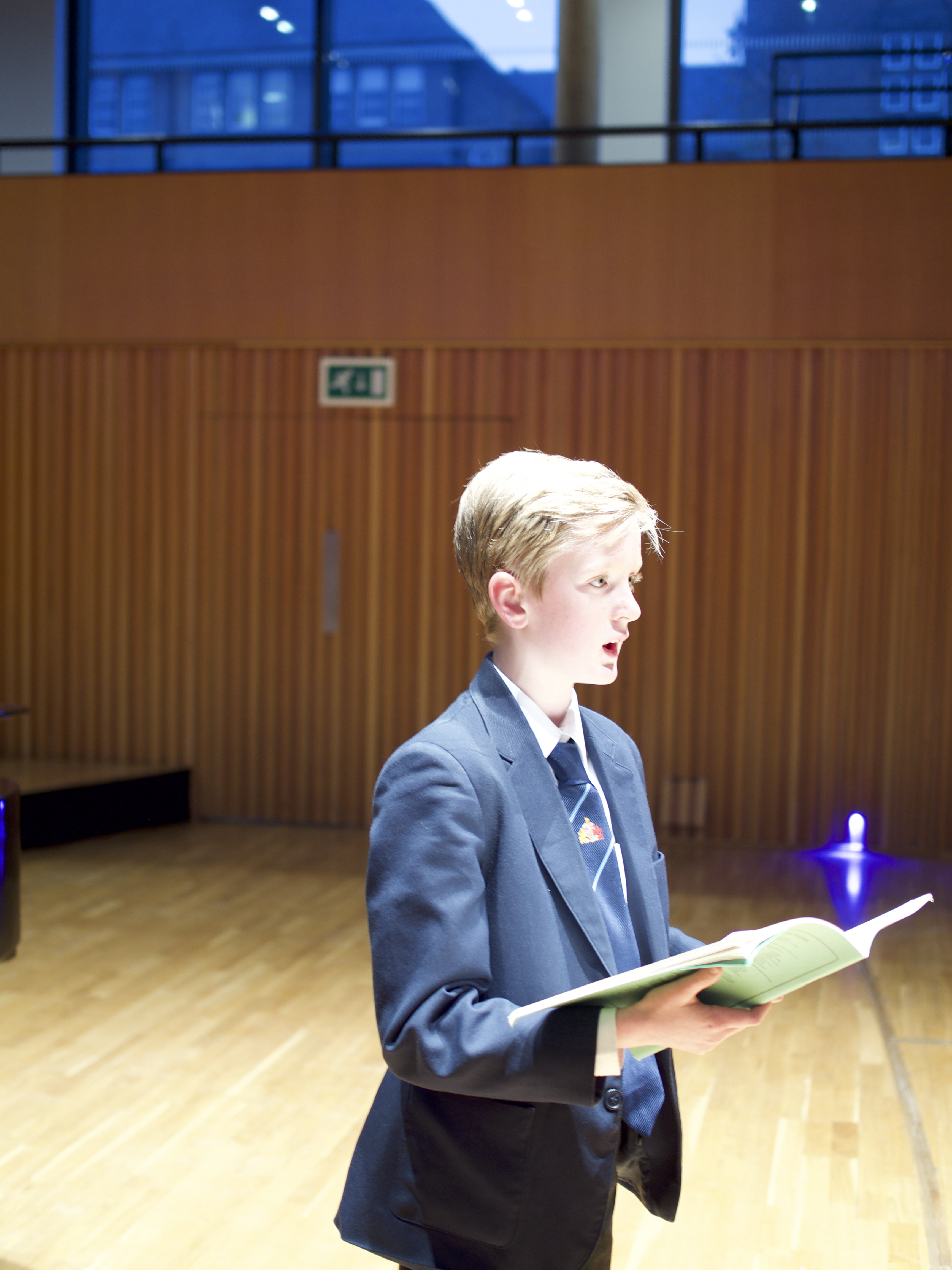

The concert is presented jointly with King Edward VI High School for Girls
The concert is presented jointly with King Edward VI High School for Girls

Dmitri Shostakovich (1906-1975): Symphony no.5 in D minor, op.47
The life and work of Dmitri Shostakovich are inextricable from the imposed Stalinist regime ever present in Russia in the early to mid twentieth century. Any analysis of his symphonies is fraught with peril: the same movement heralded as a triumphant celebration of communist ideologies by his contemporaries is now universally regarded as a powerful and subversive stance against the very people he was writing for; a forced exultation, “as if someone were beating you with a stick and saying your business is rejoicing, your business is rejoicing”. He exemplifies art’s need to be appreciated within its context.
To be a Russian in the late 1930s meant living a life entirely constructed and revolving around fear. Stalinism worked as terrorism: the regime inflicted fear for the sake of inflicting fear itself. It was impressively and horrifyingly successful. People were not only scared of their government, but of each other as well. Deep mistrust was planted by persuading the public to denounce their fellow citizens as enemies of the state. Because, to justify oppression, the state had to have enemies. When they did not exist, the state made its own people the enemy, whether or not the allegations had any basis at all. In this environment one ceased to live, merely to survive. In a country spanning two continents, every man became an island.
It was in this bleak world in which Dmitri Shostakovich read a scathing review of his beautifully experimental and satirical opera Lady Macbeth of Mtsensk on 28th January 1936. That review, although officially anonymous, was thought by all to be written by Stalin himself; the article, entitled ‘Chaos instead of Music’, threatened ‘very bad’ consequences if he didn’t abandon his pessimistic, avant-garde style (with haste). The effect of these few words is nearly impossible to quantify. Shostakovich was immediately shunned by almost everybody he knew. People crossed the street to avoid him. He was listed in the press as an enemy of the people. To know him was dangerous; to associate with him, near-suicidal. His brother-in-law, mother-in-law and uncle were all taken away. Shostakovich was not yet thirty. He had little money and his wife was pregnant. He kept a small suitcase packed for the time when the expected arrest would come.
In reaction to his attack, Shostakovich instantly withdrew his Fourth Symphony from rehearsals, fearing that the cynical introspection would prove far too unpalatable for the consumption of Russian officials. On the basis of this knowledge, the Fifth’s palpable air of protest is all the more admirable.
The opening motif of the first movement sets the precedent for the rest of the symphony: a rising interval immediately invalidated by a falling one, a juxtaposition of aspiration and exhaustion. The canon between the upper and lower strings trudges beneath a deeply melancholy melody in the first violins, building towards a brief climax before the bassoons and basses repeat the first motif, in a leaden and grotesque augmentation. We are thrown into a world in a constant battle of melancholy and mechanism. The second subject is defined by the habanera rhythm in the accompanying strings: a subtle tribute to Bizet’s “L’amour est un oiseau rebelle”, from Carmen. Conductor Vladimir Spivakov theorised that this may be a comment on love in a communist society. After all, what space is left for love in the well oiled machine of Stalin’s regime? The apparent sonata form is rudely interrupted by the central section: a grotesque march. It gathers in speed as more and more people join in and you feel that this machine’s inexorable journey towards catastrophe cannot be avoided. The state is gathering all before it and marching everybody off into a world devoid of humanity. Shostakovich resists and, in what appears as a superhuman act of will, a huge unison restatement of the opening sad and personal theme, this time fortissimo and liberated, brings the march to a halt. Perhaps it is possible to withstand a regime’s oppression; perhaps there could be freedom after all. But at the climax the marching rhythms fight back and it appears that they are the victors after all. As the army departs you hear their distant fanfares and all that is left of the people’s resistance is a lonely weeping violin solo. Maybe that will be enough. Certainly the battle is not yet over.
The Scherzo is one of the most bitingly satirical movements Shostakovich has ever penned. Opening with heavy-footed, sunken dance rhythms, the expected dance-like character isn’t immediately apparent. Shostakovich subverts this with a trite and excessively saccharin violin melody, which is usurped by the orchestra, transforming it into a galumphing parody of itself.
The Largo is the emotional core of the Fifth Symphony, and its power lies in its poignant melodies. Shostakovich chooses to exclude the brasses. Wistful cries from the oboe, a sobbing upwelling of notes from the clarinet, and a brief comment from the flute follow before the whole orchestra comes together, amidst quivering string tremolos, in heart-wrenching sadness. The pain is unbearable at times but it is not unhappy music, just deeply, deeply sad. If it is at all possible to pay tribute to every one of the seven million executions that it is estimated that Stalin ordered between 1935 and 1941, Shostakovich has done so. After all the anger and sorrow the overriding but unanswerable question is ‘Why?’.
The finale treads the fine line between sincerity and cynicism, also giving us the only concrete evidence of Shostakovich’s attitude when writing the symphony. In the period between the withdrawal of his Fourth and the writing of the Fifth, Shostakovich privately set a series of poems by Alexander Pushkin to music. The most notable of these is the poem ‘Rebirth’:
An artist-barbarian with his lazy brush
Blackens the painting of a genius
And senselessly he covers it with
His own illegitimate drawing.
But with the passing years, the alien colours
Fall off like threadbare scales;
The creation of the genius emerges
before us in its former beauty
Thus vanish the illusions
From my tormented soul
And in it appear visions
Of original and innocent times.
The appropriateness of this poem isn’t hard to miss. Shostakovich directly ‘quotes’ this in this movement, giving a slither of concrete evidence free of interpretation. As the harps play, it seems there is a possibility of surviving, the rebirth of a whole people is not an impossible utopia. Time has passed, the lies of the Stalin regime have finally crumbled, the truth has emerged. Shostakovich saw the future and was brave enough to depict it, however cryptically he needed in order to survive. In this sense the coda of the work is a victory but it is a victory against Stalin, not for him. Music’s innate ambiguity was to be Shostakovich’s saving. There is no way he would have been able to pretend to give Stalin the upbeat ending he insisted on in any other medium. Stalin demanded exultation. ‘What exultation could there be?’ Shostakovich is quoted as saying in Testimony, his memoirs.
It’s recorded that the premiere received a 40 minute standing ovation. Many of the audience were in tears. Fundamentally they were tears of gratitude that someone had had the extraordinary courage and ability to write about their times in a way that was true but also permissible. They had a voice after all. The repeated notes that end the work are shocking. That they are repeated 252 times is a sign that Shostakovich knew the battle would be a long time in winning. He knew there would be millions more deaths before the truth was discovered. Listening today to the music it is hard to imagine how anyone could have been taken in by Shostakovich’s double speak. Perhaps they weren’t. Perhaps even Stalin realised that on this occasion he had been outwitted and had no choice but to let the people’s champion get away with it. With this work Shostakovich was able to usher in a cease-fire. Unfortunately, it was not to last long.
Matthew Igoe, Divisions
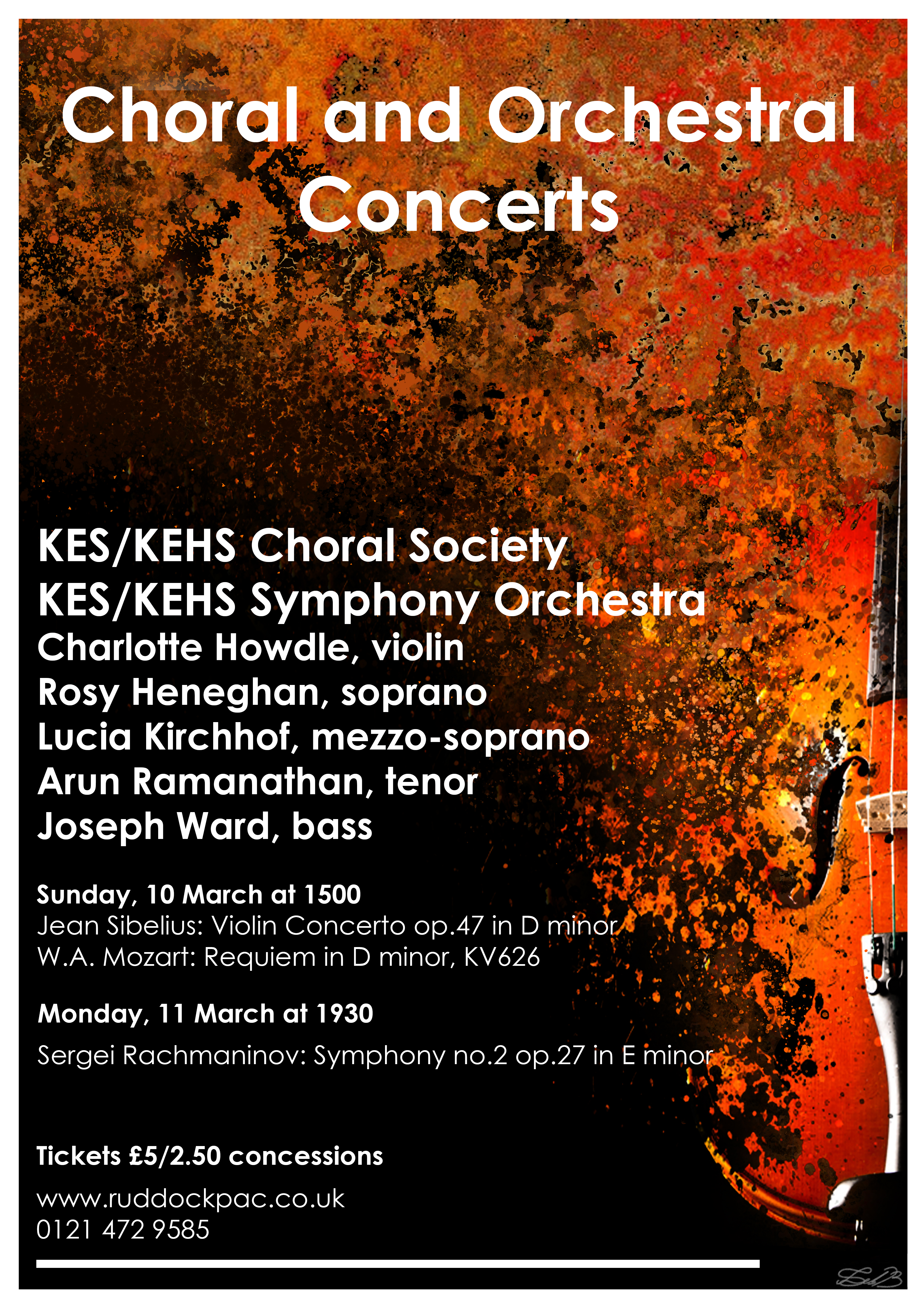
We are pleased to announce that the tickets for our Choral and Orchestral concerts are now on sale.
On Sunday, 10 March at 1500, KES/KEHS Symphony Orchestra plays Jean Sibelius: Violin Concerto op.47 in D minor. In the second half, the Choral Society will give W.A. Mozart: Requiem in D minor, KV626 with Rosy Henegan, Lucia Kirchhof, Arun Ramanathan and Joseph Ward as soloists.
On Monday, 11 March at 1930, Sergei Rachmaninov: Symphony no.2 op.27 in E minor is played by KES/KEHS Symphony Orchestra.
You can book tickets by visiting:

Monday 5 March 2018 at 18.00
Ruddock Performing Arts Centre
An informal concert given by pianists and singers from King Edward’s School and King Edward VI High School for Girls.

This recital is presented jointly with King Edward VI High School for Girls

Thursday 1 March 2018 at 13.10
Ruddock Performing Arts Centre
Isabel Russell, cello
Naomi Bazlov, piano
Melissa Yao, violin
works by Schubert, Ravel and Chopin
This recital is presented jointly with King Edward VI High School for Girls

Monday, 26 February 2018 at 18.00
Ruddock Performing Arts Centre
An informal concert given by woodwind and brass players from King Edward’s School and King Edward VI High School for Girls.
This recital is presented jointly with King Edward VI High School for Girls
Tuesday, 13 February 2018 at 18.30
Ruddock Performing Arts Centre
Wind Ensemble: Rhea Takhar, oboe; Lydia Jin, oboe; Nikita Jain, bassoon; Nathan Cornish, continuo
Bronagh Lee, violin
Sanjana Sudeshkumar, voice
Jacob Rowley, guitar
Ella Mason, trumpet
Rhea Takhar, oboe
Tom Hao, violin
Angie Qiao, piano
Samantha Burley, violin
String Quartet: Ivy Lau, violin; Bronagh Lee, violin; Junias Wong, viola; Ami Chen, cello
works by Zelenka, Prokofiev, Donizetti, Handel, Villa-Lobos, Goedicke, Rubbra, Dancla, Rachmaninov, Bruch and Borodin
This concert is presented jointly with King Edward VI High School for Girls

Monday 12 February 2018 at 18.00
Ruddock Performing Arts Centre
An informal concert given by string players from King Edward’s School and King Edward VI High School for Girls.
This recital is presented jointly with King Edward VI High School for Girls

Thursday 8 February 2018 at 13.10
Ruddock Performing Arts Centre
Peter Raven, euphonium
Rhea Suribhatla, bassoon
Piano trio: Renee Chang, violin; Enoch Cheung, cello; Lauren Zhang, piano
works by Kummer/Mead, Newton, Bozza, Saint-Saëns and Rachmaninov
This recital is presented jointly with King Edward VI High School for Girls

Thursday 1 February 2018 at 13.10
Ruddock Performing Arts Centre
Renee Chang, violin
Peter Murphy, clarinet
Beth Zheng, violin
works by Bruch, Saint-Saëns, Stravinsky, Prokofiev and Bartók
This recital is presented jointly with King Edward VI High School for Girls
Monday 29 January 2018 at 18.00
Ruddock Performing Arts Centre
An informal concert given by pianists and singers from King Edward’s School and King Edward VI High School for Girls.
This recital is presented jointly with King Edward VI High School for Girls

Thursday, 11 January 2018 at 13.10
Ruddock Performing Arts Centre
Charlotte Howdle, violin
Jessica Tedd, violin
Philip Edwards and Naomi Bazlov, violin and piano
works by Beethoven, Ysaÿe, Mozart, Kreisler and De Falla
This recital is presented jointly with King Edward VI High School for Girls
Witold Lutosławski (1913-1944): Chain 1 (1983)
Witold Lutosławski (pronounced ‘Lootoswavski’) was born in Poland in 1913. He is considered to be the country’s most important composer of the 20th century. His style both features folk-music influences, and pushes the boundaries of musical form, as we see in this piece. During WW2 he made a living playing the piano in bars. Under Soviet rule, his music was looked down on as ‘formalist’ because the communists saw it as only accessible to an elite, and they even banned his First Symphony. Lutosławski however, strove to maintain his musical integrity and refused to conform to what he perceived as a step in the wrong direction, boycotting the Polish Military Government in support of ‘Solidarity’ by refusing to perform his music.
Chain 1 was written for the London Sinfonietta in 1983 on the requests of Michael Vyner, the conductor, who had wanted to play Lutosławski’s music, but found that it was all for an ensemble either much bigger, or much smaller, than his own. That is why the piece is written for such an unusual selection of instruments. In fact, it was designed simply ‘for fourteen instruments’, but we have chosen to represent the original selection by which it was first performed. It is an intense, brooding work, full of melodic twists and turns to create both discomfort and resolution through its unorthodox structural techniques.
Lutosławski wrote three ‘chain pieces’ related only in their use of ‘chain’ form. This is an attempt to do away with conventional musical structure, creating music that neither exactly begins nor ends. Most of this piece is notated without a time signature, and the musicians rely on the conductor’s downbeats for direction. They play short motifs, in this piece specified exactly by Lutosławski, ‘in time’ according to their own intuition. The idea is that these ‘chain links’ flow into each other by merit of the musicians’ slightly differing tempos to create an unbroken musical line. Hence, every performance of this piece will be different, and yet the effect will be the same. In the later ‘chain’ pieces, Lutosławski wrote complementary ‘hexachords’ from which the musicians could create melodic lines.
The piece is made up of three sections. First, a fragmented introduction featuring overlapping ‘links’. This starts with the whole group (minus double bass) performing an introductory ‘gesture’. The section then moves through a unison passage before diverging into separate parts. This convergence and divergence is a key feature of the work, allowing Lutosławski to create structure through unifying and dividing the musical texture. Another device he uses to change the harmonic density is ‘chord aggregates’ (big piles of notes) to mark out sections. For example, both sections 1 and 2 begin with such a chord aggregate.
After this, the second section continues with a unison passage, and gradually builds up to a climax. This features ad libitum (free) sections whereby the players create their own tempo. Through this, the texture is manipulated to create the ‘chain link’ structure. Through such passages, chord aggregates, and convergence and divergence, Lutosławski subverts the normal way of writing music and constructs a piece that is almost totally original in its form and texture.
The second section ends with a 12-note chord-aggregate by way of a climax, which may be reached by the players at different moments. This will therefore be unique in every performance of the piece. It is followed by a decisive tam-tam strike, which clearly marks out the high point of the composition. From here, the third section winds the piece down through more ad libitum passages as the music slips away into an ‘inconclusive conclusion’.
When this piece was written in 1983, Lutoslawski was boycotting the Polish Government by refusing to play music there because of its repressive attitudes. This went even to the point of letting another conductor make the recording of one of his own pieces, Novelleto, for his home country. However, he did send a recording of his third symphony to be played in a church in the city of Gdansk as a political statement supporting the church and the ‘Solidarity’ movement in Eastern Europe, which was gaining significance at the time in opposition of Russian Soviet influence. He was even awarded, that year, the ‘Solidarity Prize’, which was of high significance. He is reported to have treasured this above all his other accolades as a composer.
Nathan Cornish, Divisions
Jacques Ibert (1890-1962): Cinq pièces en trio (1935)
The Parisian born Jacques Ibert received violin and piano lessons as a boy and later studied composition at the celebrated Paris Conservatoire. During his long and fruitful career, he composed in virtually every genre and, moreover, became one of the best known French composers of the 20th century.
The reed trio ensemble (oboe, clarinet and bassoon) became popular in the early 20th century, particularly after the assembly of the Paris Reed Trio by one Fernand Oubradous (1903-1986), a bassoonist, composer and conductor. Oubradous was somewhat of a polymath with a good sense of humour. When once asked to comment on reeds, he famously said, ‘have a lot of respect for them, but treat them as often as possible with contempt!’
Ibert and Oubradous became acquainted during the 1920s with the latter often conducting the prolific composer’s works. Cinq pièces was written in 1935 and dedicated to Oubradous. The work lasts for around nine minutes and is comprised of two andantes and three allegros, each sharply contrasting its preceding movement. Ibert’s genius lies in his ability to maintain strong musical unity and coherence throughout these contrasting movements, whilst also delivering a compositional style that is firmly neo-classical, charming and lyrical in character. Listen out for the wistful second Andante, which demonstrates more than a subtle nod to Stravinsky, before the final, jaunty Allegro concludes the work.
Peter Murphy, Divisions
Jacques Ibert (1890-1962): Divertissement (1930)
i. Introduction
ii. Cortège
iii. Nocturne
iv. Valse
v. Parade
vi. Finale
Jacques Ibert was a French composer who studied at the Paris Conservatoire and won its top prize, the ‘Prix de Rome’ at his first attempt, despite his studies having been interrupted by service in World War I. Divertissement is a collection of pieces drawn from the score Ibert produced for the film production of the farcical nineteenth century play, The Italian Straw Hat by French dramatist Labiche. Labiche’s comedy recounts the adventures of a nervous bridegroom on his wedding day as he attempts to find a hat to replace one belonging to a lady that his horse has eaten! His bride to be follows his frantic mission everywhere he goes, along with her suspicious father and the entire wedding party who think they are following the bridegroom to the ceremony.
Throughout the six movements, Ibert, skilfully manages to weave his own music with many other styles including blues, jazz, Viennese waltzes and music hall tunes. There’s even some spiky modernist dissonance too. Hidden within the piece’s light- hearted atmosphere, one can also hear some recognisable melodies, such as Strauss’s Blue Danube and even the parody quotation of Mendelssohn’s well-known Wedding March. These provide yet more of the piece’s many surprises…
Charlotte Howdle, Lower Sixth
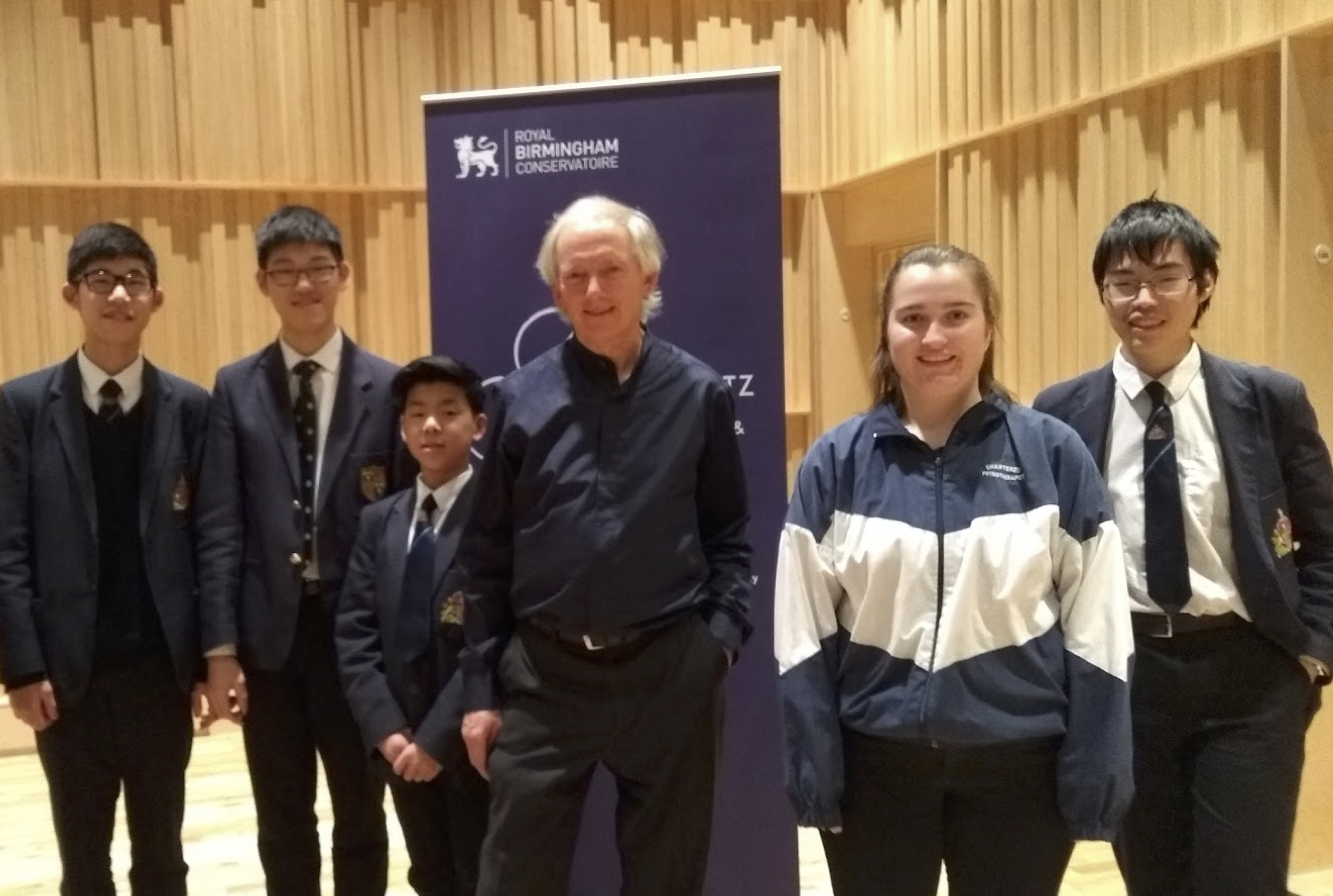
A convocation of viola greatness: members of KES/KEHS Symphony Orchestra in their safe space.
There has been speculation that there is, somewhere in the world, a mobile safe haven for violas. Its existence has since been confirmed, as the viola tribe manifested itself in the form of the Cecil Aronowitz International Viola Competition at the Birmingham conservatoire during the penultimate week of November. Violists and other supporters flocked from far and wide to listen and participate in a week of masterclasses, recitals workshops and, of course, the main event: the international competition itself.
Several members of symphony orchestra headed down on Monday to get a piece of the action: Naina played in a masterclass with Timothy Ridout and later joined the rest of the merry band in a workshop hosted by the Absolute Zero (temperature, not skill) viola quartet – yes, viola quartets do exist. The workshop was an amusing time where arrangements for viola ensemble were played and new techniques picked up. They also watched Round 2 of the competition.
The Robin Ireland evening recital included one of his own works, Pairings II for two viola, a Bach Chaconne (played with a baroque bow), Seven Preludes by Shostakovich and Six pieces from Prokofiev’s Romeo and Juliet. A magical and inspirational performance by one of the viola greats.
All in all, it was an informative and fun experience – maybe next time we’ll be competing for real! … or not.
Gabriel and Junias Wong

 King Edward's Music